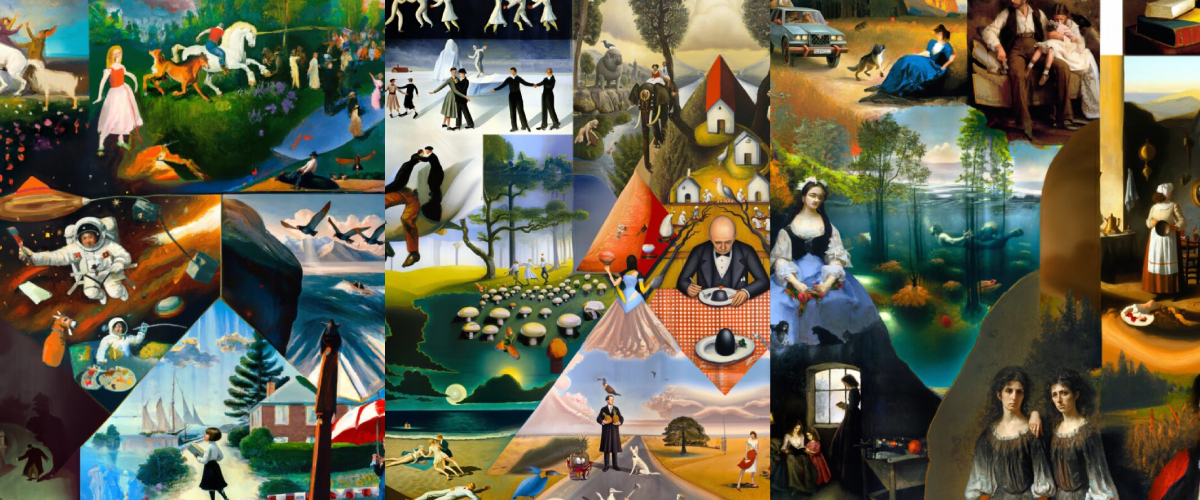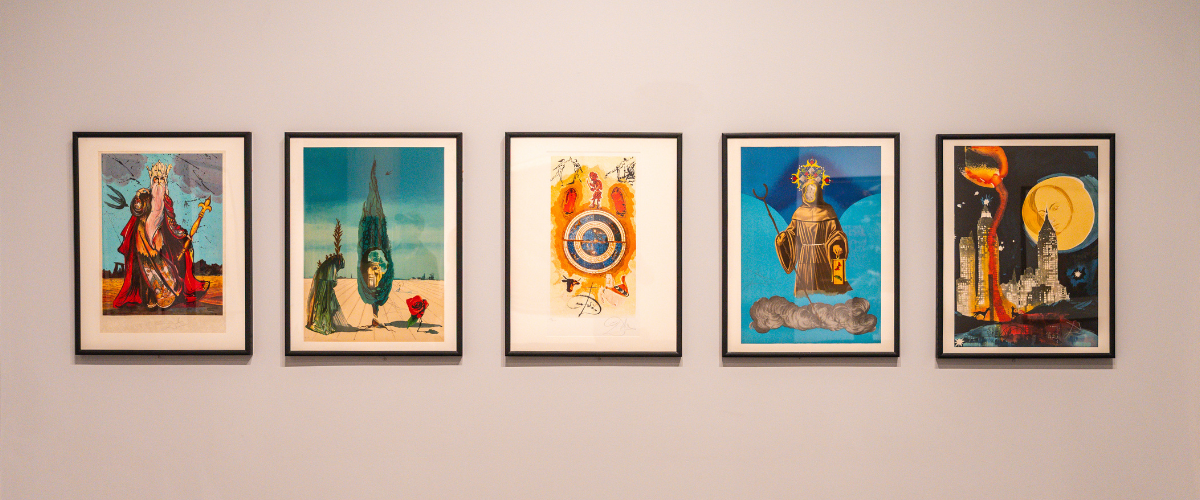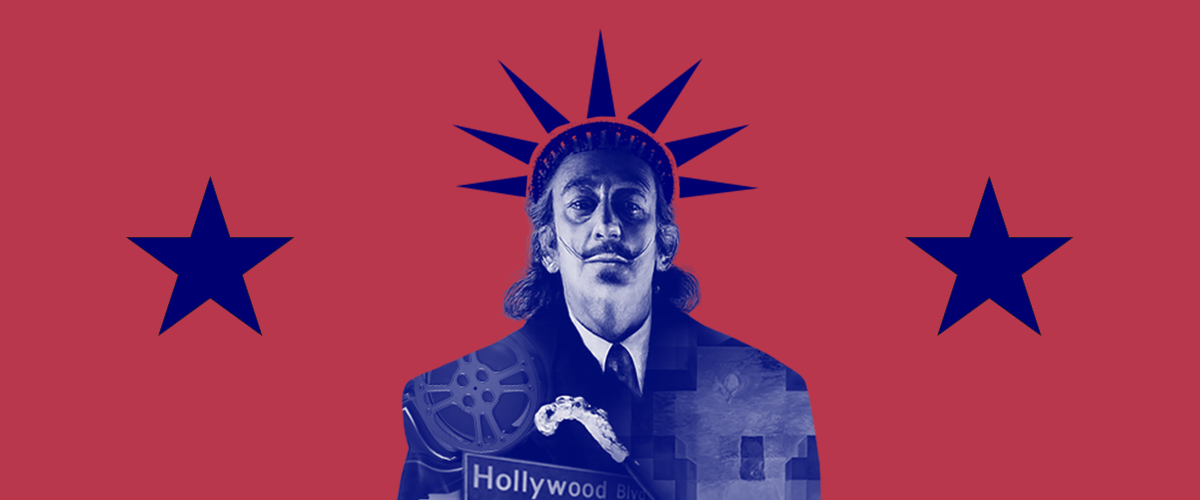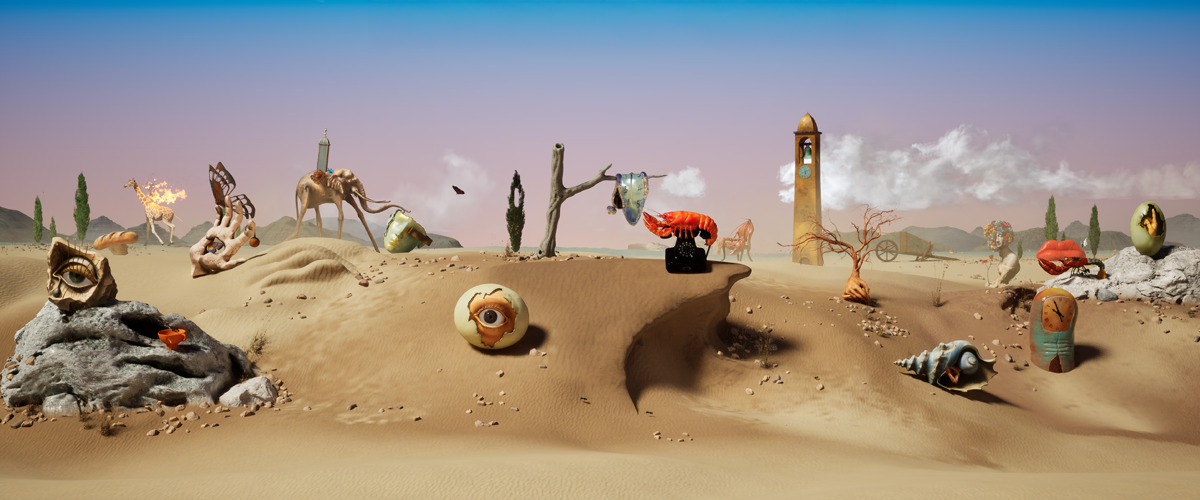
The founders of Hipstamatic the most popular camera application for the iPhone, were asked by Dalí Museum Board Member Jeff Goodby to produce a camera App for the New Dalí Museum. It was created in fall 2010 and called the Dalí Museum GoodPak. Characterized by surrealist overlays, Dalí's glowing color palette, and a randomness that allows distortion and discovery, the App is a modern day ode to the brilliance of the prominent Surrealist and blurs the line between the real and the surreal.
The camera App was immediately popular and Hipstamatic worked with the ad agency Goodby Silverstein to create a global contest, which drew thousands of entries. The contest exhorted photographers to "show John Waters your freak flag." The nine finalists and the winner selected by filmmaker and visual artist John Waters are displayed in this room. They are printed on canvas by an inkjet process.
This exhibition is created with the assistance of Hipstamatic and Goodby Silverstein. The Dalí expresses special thanks to: Jeff Goodby, Gareth Kay, Lucas Buick, Ryan Dorshorst, Brian Gunderson, Jody Horn, Carey Head, Alex Burke, Christine O'Donnell, and Mario Estrada.
On exhibition in the Raymond James Community Room until January 31, 2011
To view the winners of the "Channel Your Inner Salvador" contest, please click here
Sharing Salvador: The history of the Dali Museum and the Morse Collection May 28, 2010 - December 2010
Sharing Salvador presents a selection of paintings, objects and photographs accompanied by an historical narrative on the origins of the Dali Museum. This important exhibition-the last in our building before our opening on January 11, 2011 in the new Dali-will pay special homage to our benefactors, the Morse Family. Sharing Salvador is curated by Joan Kropf and Dirk Armstrong.
Daíi, Dance + Beyond is a new exhibition at the Dali Museum featuring never-before-displayed photographs, films, and objects documenting Salvador Dali's celebrated collaboration in the field of dance. The exhibition runs July 9th through December 31, 2010. Dali, Dance + Beyond was organized by the Godwin-Ternbach Museum, Queens College, City University of New York. Funding for the exhibition was provided by Le Musoir, the New York City Department of Cultural Affairs, the Queens College's Office of the President, and the Friends of the Godwin-Ternbach Museum.
The exhibition is curated by Frédérique Joseph-Lowery. The display at the Dali Museum is arranged by William Jeffett, Chief Curator for Exhibitions.
Dali: Gems features selections of the artist's work by celebrated friends of the Dali, including Alice Cooper, Jeff Koons,
Susan Sarandon and John Waters - and an opportunity for Dali visitors to select their favorite work of art. Drawing from the Museum's collection,
our curator, Joan Kropf, meticulously selected over 80 exquisite and rarely viewed pieces from the vault, including jewelry, paintings, drawings,
glassware, and objets d'art. The ever poplar Holograph of Alice Cooper's Brain is included.
The jewelry designed by Dali in the 1940s and 1950s is a highlight of the Dali: Gems exhibition. According to curator Joan Kropf, "Dali, inspired
by the artists of the Renaissance, designed jewels, where the craftsmanship outweighed the material value of the gold and gems. His aesthetic
sensitivity seized hold of the themes and the myths that obsessed his thoughts, transcribing into pearls and precious stones his fantastic and
symbolic world, including an interpretation of his famous melting clock as a gold and diamond brooch. Eleanor Morse, Dali museum co-founder,
wore the 13 pieces on display."
Another key work on display is Dali's Alchemy of the Philosophers, published in 1976. This rarely viewed and exceptional example of Dali's
ambitious book projects of the 1970s was painstakingly produced over a period of four years.
Finally, not to be overlooked, are the other rare gems from the collection - pieces that have remained in the vault for most of the last 27
years and have only been removed in a few instances. These include original and commercially designed items all bearing Dali's iconic images:
Venus de Milo with Drawers, 1936/1964; Birth of Venus, 1963, painted by Dali in a gold cup; the Steuben Venus with Drawers
glass bowl, 1939; Vermeil and gold Mollusk flatware, 1957; and much more.
Dali: Gems is sponsored by Franklin Templeton Investments. Additional support is provided by Chez Bryce, The Island Bistro, and Visit St.
Petersburg/Clearwater.
Traces [of the Avant-garde]: Mabel Palacín Traces Gallery - July 10, 2009- February, 2010
Una noche sin fin derives from Dalí’s persistent interest in photography and film, specifically his fascination with high-speed photography. Filmed with high-speed cameras, some parts of Una noche play in slow motion. As well, Palacín used time-lapse to speed up movement or create an animation effect. The work is a double-screen, synchronized projection presented on a seamless loop and staged in a red space which evokes the tradition of a movie theater. The sound track is made up of noises recorded in real time and a music track composed by Mark Cunningham, an American composer trained at Eckerd College and now based in Barcelona.
As part of the exhibition Palacín presents two series of photographic images derived from sequences which appear in the video. The first is twenty-four photographs from one of the high-speed sequences where a glass of wine is spilled. Here the film stills reveal the sheer density of images achieved with the high-speed camera. The other group of three images are from a time-lapse sequence, where the theater seating seems to move by its own volition in animation.
Palacín has always been interested in how still and moving images interact and how the new media of photography, film and video shape our understanding of the world. These questions directly relate to Dalí’s writing on photography. As she explains, “Dalí was fascinated with how slow motion was capable of revealing forms that the eye cannot see, and many of the figures that appear in his paintings enormously resemble those provided by the high-speed camera.”
Dr. William Jeffett, Chief Curator / Exhibitions, Salvador Dalí Museum, produced Una noche sin fin. Mirco Mejetta provided artistic direction. The project is a co-production of the Salvador Dalí Museum, the State Corporation for Spanish Cultural Action Abroad (SEACEX), the Direction of Cultural and Scientific Relations of the Spanish Ministry of Foreign Affairs and Cooperation, and the Department of Culture of the Generalitat of Catalunya (The Regional Government of Catalonia). Thanks to Sponsor Painters on Demand.
Dali, Freudz and Surrealism February 20 - November 8, 2009
Dali, Freud and Surrealism displays 70 works from the museum's permanent collection centering on two important influences in Dali's life: Sigmund Freud and the 20th century Avant-garde movement which closely based its ideas on the writings of Freud.
The exhibit spans Dali’s entire career, beginning with his earlier work where his concern with landscape and family portraits precedes the influence of Freud and Surrealism. The exhibit gives most weight to the period of the 1930s, when Dali was a surrealist and painting remarkable Freudian inspired “hand-painted dream photos.” Even after Dali parts ways with the surrealists in 1938 and pursues science and religion as his subjects, surrealist imagery and Freudian symbolism are continually present, reappearing with great force in his psychologically arresting late painting – Portrait of my Dead Brother (1963).
D a l i : Seen Through Glass June 24- November 6, 2009 (Reception held on Friday, July 10, 2009)
Salvador Dalí produced glass sculptures called pâte de verre from 1968 to 1984 for the Daum Crystal company in France. A selection of ten sculptures from our collection is on display. Daum is a prestigious French glass company recognized as one of the major forces for innovative glassmaking beginning with the Art Nouveau movement of the early 1900s to present.
Daum commissioned a few famous sculptors, designers, and painters to design limited editions sculptures for their company in 1965. The collaboration between Daum and Dalí began in 1968 with his work, Fleur du mal, a title drawn from the collection of poems by the French 19th century poet, Charles Baudelaire. Dalí was enthralled by the translucence that can be achieved in pâte de verre. In Porte-manteau-montre, 1971, Dalí utilizes the wax-like appearance of the glass to reproduce his iconic image of a limp watch draped over a metal coat hanger based on his 1931 painting, The Persistence of Memory. Dalí revisits his fascination with the Venus de Milo in Le désir hyperrationnel produced in 1984 (shown right). Early in his career, Dalí was inspired by Sigmund Freud’s psychoanalytic interpretations of dreams and the unconscious. In his Venus de Milo with Drawers, 1936 (shown right) Dalí cut six drawers into a model of the famous nude of Aphrodite. The opening in the sculpture represents an area of the unconscious which only psychoanalysis is able to penetrate. Dalí immortalizes old obsessions but also engages in a new dialogue with the modern medium of pâte de verre glass.
About the Pâte de verre Process
Pâte de verre (literally "glass paste") is ancient glassmaking technique dating back to the Egyptians over 3,500 years ago. The technique was rediscovered in the 19th century but was never widely used and only in small productions. The process utilizes the “lost wax method” of casting, the same process used to make cast bronze sculptures since the ancient Greeks. (more about the "lost wax method" wiki)
The artist’s original sculpture is reproduced in wax, surrounded with a plast mold which can withstand high temperatures. When the mold is hardened, the wax is heated and melts. Granules of glass crystals are placed in the mold and heated in a furnace to 1800ºF for a week. The crystals melt and spread throughout the mold exactly reproducing the original. The mold is cooled for 5 days and then broken open. The sculpture is chased, or smoothed, to remove imperfections under the direction of the artist. The variously colored glass crystals react with metallic oxides forming a myriad of tiny bubbles that reflect and refract, creating a mysterious inner light in the glass.
Salvador Dalí: Liquid Desire is the first comprehensive retrospective of the work of Salvador Dalí ever to be staged in Australia.
The exhibition is drawn from the holdings of the two largest collections of Dalí in the world: - the Fundació Gala-Salvador Dalí in Figueres, Spain; and the Salvador Dalí Museum in St Petersburg, Florida, USA.
From his birth in 1904 until his death in 1989 at the age of 85, Salvador Dalí’s life spanned almost a century of dramatic social and artistic change. A full retrospective, the exhibition will comprise more than 200 works in all media including painting, drawing, watercolour, etchings, jewellery, sculpture, fashion, cinema and photography. It will trace the genius of Dalí from his earliest years as a 14-year-old Impressionist painter, to the final paintings, addressing science and physics, created when the artist was in his seventies.
Salvador Dalí: Liquid Desire is a kaleidoscopic and panoramic exhibition that will surprise and delight visitors as it explores the life and art of one of the most colourful and influential figures of the twentieth century.
See a video about the exhibit featuring our Director Hank Hine here: NGV Dali video
The Hillsborough Student Surrealist Art Exhibi Friday, February 20 - Sunday, March 22, 2009
First annual juried exhibition presenting approximately 100 works by Hillsborough County middle and high school students demonstrating the ongoing popularity and attraction of Surrealism for new generations of artists. Area art teachers develop curriculum on Dali and Surrealism and use field trips as a way to prepare their students for the exhibit. The exhibition is held in the Raymond James Community Room. At the reception on March 4, students are recognized in middle and high school award categories.
Sponsors include M&I Wealth Management and Bright House Networks.
Myth in Dali's Art October 3, 2008- February 15, 2009
Salvador Dali's interest in mythology developed from his readings of Sigmund Freud, who looked to the myths of the past in order to understand fundamental principles of the human psyche. After reading Freud, Dali wrote that he was "seized with the real vice of self-interpretation, not only of my dreams but of everything that happened to me, however accidental it might seem at first glance." Seeing how Freud drew on his knowledge of classical mythology in his psychoanalytic theories, Dali constructed his own artistic identity by employing his understanding of these myths and symbols in his art and writing. In his autobiography, The Secret Life (1942), Dali borrows from myth and legend to create a fantastic persona, employing familiar myths in order to recast his life, obsessions and neuroses. For Dali, these myths allowed him to make the personal appear universal, and they provided opportunities for powerful analogies. By alluding to mythic figures such as Oedipus and Narcissus, Dali could exaggerate and recast his troubled relationship with his father and his tendency towards megalomania, bringing his personal battles to a universal stage.
Dali embraced the idea of exploring personal mythmaking, moving from classical myths to new myths based on such unusual sources as the legend of William Tell or the Angelus painting by Jean-François Millet. Dali's Memory of the Child-Woman (1931) brings together these two processes; it refers to the myth of Oedipus, which is an exemplar of a common rivalry between father and son. But the painting has a written reference to William Tell, the newer myth of the Swiss patriot and bowman who shot an apple off his son's head. Dali interpreted these legends as symbolic of paternal power and threat. In Archeological Reminiscence of Millet's "Angelus" (1933-35), Dali imagines a complex scenario of predatory female aggression. Both these myths transformed his own sexual anxieties and neuroses into universal themes.
Myth in Dali's Art curated by Joan Kropf, Dali Museum Curator of the Collection.
Wilfredo Lam in North America October 3, 2008- January 11, 2009
Wifredo Lam was born in Sagua la Grande, Cuba, in 1902. His parents were of Chinese, African, and Spanish ancestry. In 1923 Lam moved to Spain to study art at the Museo del Prado, Madrid (under a former teacher of Salvador Dali) remaining in Spain another thirteen years. After being wounded fighting on the Republican side in the Spanish Civil War, Lam moved to Paris in 1938, where he met Picasso. Picasso introduced him to artists and writers living in Paris, including André Breton, leader of the Surrealists. It was in Europe at this time that Lam first saw the African sculpture that so informed his painting.
Lam's work gained international recognition in the 1940s, with a series of one-person shows in London, Paris and New York. Between 1947 and 1952, Lam lived and worked in Havana, New York and Paris, where he eventually settled, continuing his career until his death in 1982. His work can be found in major museums throughout the world, including New York's Museum of Modern Art and the Tate Modern in London.
Lam contributed a non-European Afro-Cuban voice to Western art, synthesizing Cubism, Surrealism, "primitivism," Négritude (Black Identity), Afro-Cuban history, and the African-derived Santería religion. "Over time competing interpretations of Lam's work have been offered. Initially he was presented as a Surrealist and Primitivist, his work seen as a fusion of non-Western and Western meanings into a kind of universal myth," said William Jeffett, Dali Museum Curator of Special Exhibitions. "More recently his mature work has been presented as challenging Western models of Modernism from the vantage point of post-colonialism and Afro-Cuban identity. It is now clear that Lam was intellectually engaged with contemporary anthropological analyses: whether those generated in Europe by figures such as his close friend Michel Leiris (Head of African Art at the Musée de l'Homme) or closer to home in Cuba, where Fernando Ortiz, Lydia Cabrera, Alejo Carpentier opened the critical discussion of Santería."
Organized by the Patrick and Beatrice Haggerty Museum of Art, Marquette University, Milwaukee, WI.
Its presentation in St. Petersburg is curated by William Jeffett, Dali Museum Curator of Special Exhibitions. Dr. Jeffett is an international authority on Salvador Dali and modern Spanish art. Prior to coming to St. Petersburg the exhibition has been presented at the Haggerty Museum of Art, the Miami Art Museum and the Museum of Latin American Art, Long Beach, California.
SPONSORED BY: Raymond James Financial, Cigar City Magazine, The Columbia Restaurant, St. Petersburg Times, Univsion
Women: Dali's View June 13 – September 24, 2008
A selection of over 90 works from the permanent collection (painting, drawing, watercolors, prints and objects) representative Dali's various creations of the female image.
The selected works help trace the progression of Dali's depiction of women from his early student days - images of varioius women as models in academic studies - to a later period when Gala becomes his chief model and muse. As a young man, the artist's sister Ana María was a prominent model. Girl's Back (1926) depicts Ana Maria's head as viewed from behind in a Renaissance style. By 1928, Dali is searching for a more experimental style – and the woman in The Bather takes on disconcerting transformations and fragmentations. Dali's treatment of the female during the Surrealist period varies, at times imbued with a disturbing eroticism, or evoking maternal and the "eternal feminine" interpretations based on mythological figures. In a mid-career work, Enchanted Beach with Three Fluid Graces (1938), Dali treats the three female figures as the Three Fates.The surrealist and Freudian muse Gradiva becomes the spectral image of a woman as the object of obsession and the repressed forces of unconscious desire. His wife, Gala who becomes his exclusive model, is shown in this exhibition to gather all the many guises of woman.
The exhibition curated by Joan Kropf and Dirk Armstrong.
SPONSORED BY: House of Ska, Ovation by JMC Communities, Northern Trust, DuPont Registry, Skirt Magazine, The Table Restaurant
See PICTURES of the opening reception on June 13, showcasing local House of Ska designers - Ivanka Ska, Ungala and Aleka Phoenix.
DALI & FILM February 8 - June 1, 2008
The Dali Museum in St. Petersburg presents Dali & Film, the first exhibition examining the profound relationship between the paintings and films of Salvador Dali (1904-1989). The exhibition reveals how Dali combined his skills in painting with the new and exciting possibilities of the moving image to define a new art.
Featuring over one hundred works from collections from all over Europe and America, together with films, photographs, film scripts, and drawings, Dali & Film opened at the Tate Modern in London, and the Los Angeles County Museum of Art, and will be displayed at the Museum of Modern Art in New York City in 2008. For the exhibit at The Dali Museum in St. Petersburg a number of important works drawn from the Dali Museum's own extensive collection have been added, including The Disintegration of the Persistence of Memory (1952-54), and The Ghost of Vermeer of Delft which can be used as a Table (1934).
Dali & Film is curated by Tate curators Helen Sainsbury and Matthew Gale (editor of Dali & Film); Dawn Ades, Dali scholar and curator of Salvador Dali: Centenary Exhibition; Montse Aguer, Director, Centre d'Estudis Dalinians, Gala-Salvador Dali Foundation; and Félix Fanès, curator of Dali and Mass Culture. The exhibition in St. Petersburg is curated by William Jeffett, Curator of Special Exhibitions, Salvador Dali Museum.
The St. Petersburg presentation is made possible by the St. Petersburg Environmental Research Corporation and by Progress Energy, a Museum sponsor since 2002, whose continued support for arts provides a benchmark for corporate engagement in the community. Presenting Sponsors for the St. Petersburg exhibition include Ovation by JMC Communities and M&I Wealth Management with additional support from the Renaissance Vinoy Resort and Golf Club, and Visit St. Petersburg/Clearwater.
DALI IN FOCUS July 13, 2007 - January 2008 / Morse Galleries
Encounter Dali in depth through a selection of paintings from the Museum's permanent collection displayed with a focus on the hidden details. Seven works will receive a closer examination for Dali's particular blend of personal interpretation. Assisted by dynamic visual aids and illustrated panels, the paintings are interpreted section-by-section to analyze the dreams, desires and memories that inspired the work.
Curated by Joan Kropf, Curator of the Collection.
Catering Associate Sponsor: Savor
Auto Associate Sponsor: AutoWay Ford of St. Petersburg
THE FINE ART OF COLLECTING DALI June 22 – January 2008 / Traces Gallery
The Dali Museum, St. Petersburg, Florida, has been home of the most comprehensive collection of Salvador Dali's works in America for 25 years. But how did this revered collection come to be? This cultural treasure is the result of A. Reynolds and Eleanor R. Morse's 45 year friendship with Salvador and Gala Dali, and their profound commitment to buying the artist's work starting with their first acquisition, Daddy Longlegs of the Evening…..Hope! (1940).
A meticulously assembled archive of the Morses' research, purchase history. anecdotes, travel logs, and photographs allows us to uncover our paintings' unique stories. The Fine Art of Collecting Dali examines the story of the paintings from the hands of the artist to their permanent home in The Dali Museum.
Curated by Elen Woods, Assistant Curator.
STUDENT SURREALIST Art Exhibit November 23, 2007 - January 20, 2008 / Raymond James Community Room
For the 23rd consecutive year, The Dali Museum in St. Petersburg is proud to present the Student Surrealist Art Exhibit, an annual, juried exhibition of artwork produced by Pinellas County middle and high school art students from private and public schools. The exhibition will open at The Dali Museum on Friday, November 23, 2007 and will run through Monday, January 21, 2008.
The theme, "Surrealism, Dreams and Fantasy," invites students to explore their imagination and challenge their creativity using concepts, themes and methods similar to Dali and his Surrealist contemporaries. Sponsored by Dali Museum Trustee, Sonya Miller, the juried exhibit includes 100 works, produced in various media including oils, pastels, photography, and computer graphics and allows the Dali Museum to recognize and celebrate the talent of both Pinellas County art students and their teachers.
Sponsored by Sonya Miller, Patricia Gorman and Cynthia Hanks.
Dali's 'Biblia Sacra' April 20 - July 29 2007 & August 3 - November 18, 2007 / Raymond James Community Room
After establishing a friendship with Dali over the course of several years, Dr. Giuseppe Albaretto commissioned the artist to create 100 paintings based on passages selected from the Latin Vulgate Bible. Giuseppe was a passionate Catholic and stated in an interview in 1995: "I did everything I could to persuade him to meditate on the Catholic religion". He hoped that the project would lead the artist to a closer relationship with God and to alleviate his perceived domination of the artist by his wife Gala. The results of the Albaretto commission grew to one-hundred and five pieces that were completed between 1963 and 1964. The original illustrations were completed with a combination of gouache, watercolor, ink and pastel. This is the premier exhibition of these prints at The Dali Museum, and will be shown in two separate presentations.
Curated by Dirk Armstrong, Assistant Curator.
DALI & THE SPANISH BAROQUE February 2, 2007 - June 24, 2007 / Morse Galleries
The exhibition presents Spanish master paintings alongside works by Dali from the Museum's permanent collection, demonstrating the importance of the incorporation of elements from Baroque painting into Dali's approach to painting and its pictorial language. Dali made frequent reference in his writings and even in the titles of his work to Baroque masters, which set himself up as a modern equivalent to artists such as Velázquez.
Co-curated by Dr. William Jeffett and Suzanne Stratton-Pruitt.
Sponsored by Season Sponsor Progress Energy
Additional support provided by The Embassy of Spain and Northern Trust Bank
Media Support provided by The St. Petersburg Times
Hospitality Associate Renaissance Vinoy Resort and Golf Club
MULTIMEDIA: » Interview with the Curators on the exhibit Dali & The Spanish Baroque
Dali by the Decades August 4 2006 - January 2007 / Main Gallery
A chronological exhibition of oil paintings, drawings, watercolors and objet from the Museum's permanent collection cast against interpretive material including photographs, text and graphics showing the changing context - personal life and cultural times - in which Dali lived and created. The dynamic and tumultuous time between the two World Wars acted as a catalyst for the development of Surrealism and reflects Dali's particular blend of integrating his personal symbolic interpretations within the context of universally recognized symbols.
Curated by Joan Kropf, Dirk Armstrong and Elen Woods.
Season Sponsor: Progress Energy
Dali & the Zodiac August 4 2006 - January 2007 / Raymond James Community Room
This exhibition will seek to unveil connections between various definitions of the Dali Zodiac in four sections. One section will display the Dali Zodiac print suite; which will be supplemented by general information specific to each astrological sign. This will be complimented by a didactic representation of Dali's own Zodiac, supporting and expanding upon the biographical information on Dali presented in the main galleries. The last two sections have a more historical perspective, addressing the history of the Zodiac group and the origins of Catalan Mysticism.
Curated by Elen Woods and Peggy McKendry.
Season Sponsor: Progress Energy
Illumined Pleasures: Dali and Early Cinema August 4 - January 2007 / Traces Gallery
Exhibition outlines connections between Dali and the cinema of the early 20th century. It provides a glimpse into the cinematic world of Dali's youth, presenting fantastic, comedic and animated work by filmmakers who influenced Dali in his formative years. They paved the way for the cinematic style of his Surrealist canvases and his successful cinematic collaborations with Luis Buñuel, Walt Disney and Alfred Hitchcock. Exhibit also suggests how Dali's dreamlike universe influenced Hollywood. Both Dali and Buñuel's Un Chien Andalou and the artist's revolutionary dream sequence for Hitchcock's Spellbound are shown.
Curated by Peter Tush.
Season Sponsor: Progress Energy
Salvador Dali and a Century of Art from Spain: Picasso to Plensa May 5 – July 30, 2006 / Main Galleries and Raymond James Community Room
If the 20th century was tumultuous – in its scientific and medical discoveries, its wars, annihilations, and migrations – it was equally dynamic in its art. The ways in which art engages the world was in this period as varied and vehement as our history. Although the art of this century – known as modern and contemporary art – is often identified with Paris, an alternative center for its development is Spain. This exhibition explores that idea. Presenting many examples of Salvador Dali's work, our exhibition explores the major artists and artistic inventions of the period as embodied in the art of Spain. Beginning with Pablo Picasso's first Cubist sculpture and ending with the renowned contemporary sculptor Jaume Plensa, the exhibition provides a view of Dali's influential work alongside eminent modern and contemporary Spanish art borrowed from leading museums around the world.
Co-curated by William Jeffett and Ellen Landis; organized by Albuquerque Museum of Art & History and The Dali Museum. The exhibition is sponsored by Raymond James Financial, WVEA TV-Univision & WFTT-TV 50 TeleFutura.
Pollock To Pop: America's Brush With Dali December 9, 2005 - April 28, 2006 / Main Galleries 4-7
After wowing audiences since December, Pollock To Pop: America's Brush With Dali will end its limited run on April 28. Visitors have described the exhibition as awesome, fantastic, amazing, and a treasure.
The Dali Museum assembled Pollock To Pop: America's Brush With Dali with some of the most significant works of modern art borrowed from major American museums including the Metropolitan Museum of Art in New York, the National Gallery of Art in Washington D.C., the Philadelphia Museum of Art, private collections and foundations.
Pollock To Pop: America's Brush With Dali presents American Abstract Expressionist and Pop Art works in dialog with one another and with the art of Salvador Dali from that era. In addition to Dali, major artists represented include Jackson Pollock, Andy Warhol, Chuck Close, Roy Lichtenstein, Mark Rothko and James Rosenquist.
This exhibition was sponsored by Progress Energy
Dali Under the Influence November 27, 2005 - April 28, 2006 / Main Galleries 1-3
This exhibition of Dali works from our Museum collection, is presented in conjunction with our special exhibition Pollock to Pop: America's Brush with Dali. The aim of this exhibition is to acknowledge the breadth of the historical influences on Dali.
This exhibition was sponsored by Progress Energy
Exhibition Posters from The Dali Museum Archives April 12 – May 2, 2006 / Raymond James Community Room
This exhibition features 21 posters selected from the museum archives for a one-month presentation in the museum's Raymond James Community Room. The selections include promotional posters from both The Dali Museum in Florida and the Fundacio Gala-Salvador Dali Museum in Figueres, Spain; as well as examples from museum and gallery exhibitions held in Japan, Spain, Italy, Scotland, The Netherlands, and New York. Also featured in the show is the Dali-designed promotional poster for the Museum of Modern Art's Dada, Surrealism and Their Heritage exhibit in 1968.
Student Surrealist Art Exhibit February 23- April 2006 / Raymond James Community Room
The annual "Student Surrealist Art Exhibit" is a juried competition for Pinellas County middle and high school art students from public and private schools. Through this exhibit, the Dali Museum recognizes and celebrates the talent of Pinellas County art students and their teachers. The theme, "Surrealism, Dreams and Fantasy," invites students to explore their imagination and challenge their creativity using concepts, themes and methods similar to Dali and his Surrealist contemporaries. Private Reception March 8, 6-8pm. Winners will be announced March 8th.
Scholastic Art and Writing Awards Exhibition February 3 – February 19 2006 / Raymond James Community Room
Juried art show featuring work by Pinellas County students selected for the national Scholastic Arts and Writing Competition. Organized by the St. Petersburg Festival of States. Raymond James Community Room. Private reception February 10, 6-8pm
Tilting at Windmills: Dali Illustrates Cervantes' 'Don Quixote' April 2005 - January 2006 / Raymond James Community Room
In celebration of the 400th anniversary of the publication of the first volume of Miguel Cervantes' Don Quixote de la Mancha, The Dali Museum presents an exhibition featuring Dali's illustrations of this classic work of literature.
DALÍ REVEALED: Land, Myth, Perception and God February - December 2005
This exhibition organizes Dali's work into four persistent categories of obsession: Land (the landscape of Catalonia); Myth (both classical myths and the highly personalized mythology Dali constructs); Perception (the elasticity of reality and vision and demonstrated by optical illusions and double images); and God (themes of theism [Catholicism] and atheism). It reveals a mind laden with traditions yet heroically striving to demonstrate what else the world might be.
DALÍ CENTENNIAL: An American Collection January - August 2004
This centenary exhibition is a retrospective of the permanent collection. The exhibit outlines Dali's career from the formative years 1917-1918, his notable Surrealist period 1919-1940, and his later works from 1941-1970. The exhibition features the multifaceted aspects of the artist's work, showcasing the extensive and varied material the Museum owns in a variety of media.
Curated by Joan Kropf, Dirk Armstrong and Kelly Reynolds.
IMAGINARY GARDENS: Joan Fontcuberta Mapping Dali's Landscapes September 2003 - January 2004
Installation show designed specifically for the Dali Museum and responding to the Museum's collection by the Barcelona-based Catalan photographer. Fontcuberta's work questions the notion of "truth" as constructed by the photographic medium, particularly in the context of the digital age when the already fragile "reality" can be so easily manipulated.
Curated by William Jeffett.
SALVADOR DALÍ: Hand Painted Dream Photographs Selections From the Permanent Collection September 2003 - January 2004
In 1935 Dali wrote of painting, as "instantaneous color photography done by hand..." For him painting aspired to photography, with the technique so refined that it erased the artist's hand. If Dali moved from painting towards photography, so Fontcuberta has moved from photography towards painting. In doing so has questioned the truth-function of photography, asserting its artistic role.
DALÍ & MASS CULTURE October 2004 - January 2005
Dali & Mass Culture is the only American showing of a landmark international exhibition presenting over two hundred and seventy Salvador Dali works in film, fashion, painting, photography, plus images from Dali's Surreal World's Fair fun house and the first ever showing of Dali's paintings for Disney. Most of the exhibit works will be seen here for the first time — only nine paintings from Museum's permanent collection. The Dali/Disney collaboration Destino, an animated short film, is shown daily during the entire run of the exhibition.