surreal shapes and structures
Fashion Design at The Dalí is a free program that allows artistically inclined middle and high school students from the Tampa Bay area to learn the fundamentals of design, construction and fashion presentation from experienced artists and designers. With upcycled materials and innovative techniques, students are invited to think creatively to produce wearable works of art.
This year’s theme, “Surreal Shapes and Structures,” invites students to consider the many forms used in both Salvador Dalí’s paintings and Alberto Giacometti’s sculptures. From gelatinous, flowing shapes to thin, rigid structures, students will select an inspiration object from The Dalí’s Permanent Collection or Alberto Giacometti & Salvador Dalí, this winter’s special exhibition at the Museum.
We thank Herrig Center for the ARTS in Bradenton, Florida for their partnership in this student exhibition. The students’ designs will be on view at Herrig Center for the ARTS from March 23–April 18, 2026. The center is open Monday–Saturday 9am-5pm, closed Sunday. Learn more about Herrig Center’s other exhibitions and classes at herrigcenter.org or visit the galleries at 888 3rd Avenue West, Bradenton, Florida 34205.
Alisa Ekimkina
My name is Alisa Ekimkina. I am 13 years old and I am a student at Timber Springs Middle School in Orlando and I grew up in St. Petersburg, Russia. When I was younger, I loved learning and doing creative things. I started ballet at an early age and it taught me discipline and patience. Later, I began playing the piano and music helped me express my feelings. One of my earliest memories is traveling to Spain with my family. That trip stayed with me and helped shape how I connect to art and culture today. It is also part of why I feel connected to Salvador Dalí and his Spanish roots.
As I got older, theater became very important to me. In sixth grade, I joined Junior Thespians and discovered costume design while working on shows. I realized how much I loved creating things and how costumes help tell stories and bring characters to life. I also performed with Orlando Family Stage for several years, both on stage and backstage. In 2025, I received a Thespians award for costume design. At home, I enjoy designing and sewing tops, corsets and accessories using my sewing machine. Outside of fashion, I still love playing piano, dancing, doing theater and traveling.
I chose Ocell…Peix (Bird…Fish) and Javanese Mannequin by Salvador Dalí because of how surreal they look and how strong their emotions feel. Both artworks show a feeling of being trapped and a strong wish for freedom. In Bird…Fish, the bird and the fish seem to struggle to separate, as if they are stuck between two states. The dark colors make the painting feel sad, but the light and birds suggest hope. In Javanese Mannequin, the mannequin standing alone in an empty space feels isolated and confined. These works are sometimes overlooked in the Museum, but they are very interesting when you look closely. I like their textures, layers and hidden meanings. They were made in very different periods of Dalí’s life. Together, they show two sides of his thinking. One is soft and organic and the other is rigid and structured. This contrast connects strongly to the theme “Surreal Shapes and Structures” and inspired my costume design.
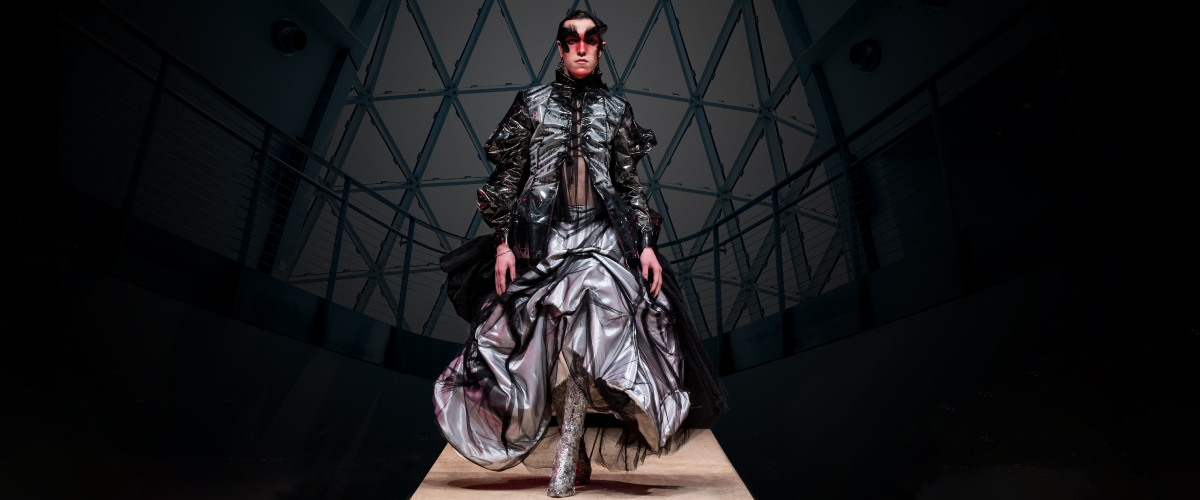
My costume design is inspired by both paintings and shows the feeling of confinement found in them. From Ocell…Peix, I used flowing shapes, soft lines and the idea of transformation. From Javanese Mannequin, I took strong structure, rigid lines and a constructed silhouette. While sewing, I used black thread and made the stitches visible on purpose. I focused on form, volume, layering and texture. The costume includes a corset, a skirt, a belt and an outer corset shaped like ribs. I combined soft fabrics with harder materials to turn the paintings into wearable art. Gold details make the body look restricted and controlled. I added spikes to show isolation and to reference the Statue of Liberty as a symbol of hope and freedom. The seven spikes represent the seven seas and connect freedom to movement and the wider world. This also references Dalí’s American period. The corset is covered with sheer black fabric to show darkness and restraint. Under the skirt, colors inspired by the paintings appear as the fabric moves. They represent hidden hope and the desire for freedom. The ribbons and wave-like movement of the skirt are inspired by traditional Spanish clothing and reflect Mediterranean warmth and flow. I also added accessories like a red glove, red stockings and sandals inspired by details from the paintings. Like Dalí’s art, my design has hidden meaning and combines emotion and visual style. I wanted to use mostly recycled and reused materials. Most of them came from my home. The gold, green, yellow, red and black sheer fabrics were originally ribbons. The black skirt was reused from an old dress. The only materials I bought were wire and a corset. Form was very important to me, so I used wire in different thicknesses. Thicker wire was used for the gold structural elements, including the rib-like corset and the belt with seven spikes. Thinner wire helped create wave-like movement in the skirt so it could hold its shape and still flow. I also reused an old belt to support the structure.
I started with a simple idea, but the design changed as I worked. I made my own design instead of using a pattern. One challenge was finding gold fabric. When I could not find any, I decided to use ribbon instead, which made the design more interesting. Working with wire was also hard. It was difficult to bend and keep upright, so my dad helped me shape and secure the pieces. In the middle of the project, my sewing machine broke and my mom and dad helped fix it so I could keep working. I changed some details along the way, like colors and small elements, while keeping my main idea. The process was harder than I expected, but also very rewarding. I am very thankful to my family for their help and support.
Through this program and my design process, I learned a lot about fashion design, materials and technique. This was one of my first full design projects and it helped me understand how an idea becomes a finished piece. I learned to use a sewing machine more confidently. I learned how to control stitches and solve problems. With help from Ms. Donnelly, I became more independent in my work. I also learned how to use wire to create structure and movement and how different materials work together. I also learned more about Salvador Dalí and his influence on fashion. Learning about his ideas helped me see how art and fashion can connect in creative ways. This experience helped me become more confident and confirmed that I want to continue working in costume and fashion design.
Yamielis Viera Ortiz
My name is Yamielis Annet Viera Ortiz. I am 14 years old and a student at Rampello K-8. Fashion has fascinated me for as long as I can remember. My passion for style and creativity has been shaped by my family and the vibrant culture of my home, Puerto Rico. Growing up surrounded by so much diversity has inspired me to explore different styles and express myself through fashion. I am proud to bring my unique perspective and cultural heritage into everything I create.
When I first encountered Girl with Curls by Salvador Dalí, I was immediately transported back to my island, Puerto Rico. The painting’s dreamy landscape and the elegance of the woman’s pose resonated deeply with me, echoing Dalí’s intention to add romance and mystery to his work. I wanted to embrace and celebrate the beauty of the woman in the painting, just as Dalí did, and channel that same sense of wonder into my own design.
My design draws inspiration from the golden curls, the lush green land, and the expansive blue sky that remind me of El Morro in San Juan. These elements are not only visual motifs but also emotional connections to my heritage and the vibrant culture that shapes my creativity.
To bring my vision to life, I selected golden fabric, blue and green yarn, and green gems. Each material was chosen to reflect the colors and textures of the painting, as well as the spirit of my island.
The process began with sketches, and with the support of my mom and cousin, I was able to transform my ideas into a tangible dress that bridges art and reality.
Participating in the Salvador Dalí Fashion Program has taught me that imagination and surrealism can be woven into the clothes we wear. I have learned new techniques and discovered that fashion is a powerful way to express both personal and cultural identity. This experience has inspired me to continue exploring and sharing my unique perspective through design.
Kaylee Schauer
My name is Kaylee Schauer, and I am a sixteen-year-old sophomore at Palmetto High School. I have maintained a strong passion for art since the age of six. What began as a creative interest gradually developed into a serious pursuit when I sold my first painting at the age of eight. By twelve, I began entering art competitions in painting and drawing, earning recognition at the county, state, and national levels. At thirteen, I became one of the youngest fashion designers selected for the Dalí Museum Fashion Program, an experience that further strengthened my interest in wearable art. I have attended educational art camps at the The Dalí Museum for the past six years, which have significantly influenced my artistic growth and understanding of art history and design.
In addition to my artistic pursuits, I am actively involved in both Future Farmers of America (FFA) and 4‑H. Through these programs, I raised a 200-pound market hog named Cali for exhibition at the Manatee County Fair and grew plants to sell at the fair. These experiences have helped me develop responsibility and a strong work ethic, both of which influence my creative process.
I selected Cadaqués by Salvador Dalí as inspiration for my design because I had prior knowledge of the piece, having previously researched and presented on it during Junior Docent Art Camp. I was immediately drawn to the movement and color palette of the painting and recognized its potential as a foundation for a fashion design. My familiarity with the artwork allowed me to approach the project with confidence while still giving myself creative freedom to interpret the piece in my own way.
My design reflects the original artwork through both color and structure. I incorporated the green tones of the olive leaves into the bodice and outer skirt of the dress. The background hills in the painting are terraced, which inspired me to hand-sew individual folded lines throughout the bodice to mimic the appearance of terracing. To add contrast and visual interest, I designed the underskirt using the bold colors of the hot air balloon depicted in the artwork. Additionally, the back of the skirt features cubes in the same color scheme, referencing the painting’s significance as one of Salvador Dalí’s early explorations of Cubism. Overall, my design reflects both the thematic meaning and the visual aesthetic of the original work by combining cubist elements, terraced textures, and a cohesive color palette.
The fabrics used in this design were purchased from Hobby Lobby. The bodice is constructed from sage green satin, while the underskirt is made from red, orange, green, yellow, and blue broadcloth. The outer skirt was created using sage green chiffon to achieve a soft, flowing effect. To construct the bodice, I used a zip-up corset purchased from Amazon as a structural base and hand-sewed the satin fabric onto it.
The design process was both challenging and rewarding. I began with several ideas but struggled to determine the most effective approach. My original plan involved embroidering numerous olive leaves to apply to the dress; however, I later realized that this method was impractical. After reconsidering my approach, I chose to incorporate cubist-inspired shapes instead. I also debated various techniques for attaching the fabric to the corset and eventually learned that hand-sewing each individual line was necessary. Although this realization initially caused concern, the final result exceeded my expectations and reinforced the importance of patience and precision.
Throughout this project, I learned several new techniques commonly used in the fashion industry. Ms. Donnelly taught me how to execute a backstitch, which I used to hand-sew the entire bodice. She also showed me how to efficiently thread a needle and adjust a zipper when it requires additional closure. At home, I learned how to create a folded hem using an index card as a guide while working with my sewing machine. This project was also my first experience working with satin, which taught me that different fabrics require different handling techniques.
Overall, this experience taught me that initial ideas often need to be adapted in order to achieve their full potential. The process challenged me both creatively and technically, ultimately strengthening my skills as a designer and reinforcing my passion for combining fine art with fashion.
Annabella Triola
My name is Annabella R. Triola and I’m a junior Technical Theater major at Jonathan C. Gibbs High School. I love theater, have volunteered at The Dalí Museum for years, and am in multiple clubs like book club and debate. I mostly spend my weekends relaxing at home and cuddling with my cats.
I chose Archeological Reminiscence of Millet’s Angelus by Salvador Dalí and Mère et Fille by Alberto Giacometti. I loved the silhouette and colors of the pieces. In both of them, the blues contrast with the golds and browns. The relationship between mother and child in both paintings made the connection even more apparent to me.
My design relates to the pieces by incorporating multiple thematic elements from both paintings and mimicking shapes present in them. The hooded figure helps emulate the tall forms, while the bow and swooping shapes help represent a child like the one in Mère et Fille.
I used printed fabric and a polyester blend. I bought everything new, but I made the polyester specifically my own by painting it with acrylics.
My process was very “go-with-the-flow.” I didn’t use patterns, except for a hood pattern piece that I modified. Otherwise, I mostly used measurements and my hopes and dreams. But I think it turned out almost perfect to how I envisioned it.
I learned that sewing is actually really fun if you aren’t super stressed over a Vogue Patterns pattern. It was interesting seeing how my fabric reacted to being painted on, and learning how to implement my design in a more discreet way was definitely challenging.
Keagan Herwander
I’m Keagan Herwander, a junior at Jonathan C. Gibbs High School. I am a Technical Theater and Design major. I have always loved to sew, even when I was little. I would mend my stuffed animals and make them little dresses.
I chose The Lane to Port Lligat with View of Cape Creus by Salvador Dalí. I was drawn to its colors, and the painting almost seems to glow. Those qualities were a real inspiration when designing.
My design relates to the piece through its colors and elements from the painting. The trees and the amber glow helped shape my vision. Most of my inspiration came from the aesthetic elements of the painting.
Most of the fabric I used for my design I already owned. However, I purchased the green tulle and metal wire.
I used metal wire to help keep the shapes structured throughout the garment, especially for the back skirt. I patterned the whole garment myself. I also learned how to make a bust cup with the helpful guidance of Ms. Donnelly. I learned a lot through trial and error during the construction process.